Seeing red and black bugs in Ontario can be confusing, especially when the insects look like beetles at first glance. One important possibility is the European firebug (Pyrrhocoris apterus), a red-and-black true bug that has been documented in Ontario.
The first step is identification. Not every red-and-black insect is a beetle, and similar-looking insects can have different characteristics. European firebugs are generally considered harmless to people, pets, and plants, so confirming what you are seeing can help you avoid unnecessary pest treatment.
What are the red and black bugs found in Ontario?
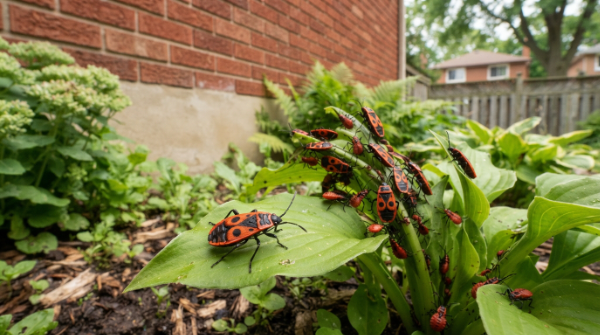
European firebugs are red-and-black insects that can easily be mistaken for beetles. They have a predominantly red body with distinctive black markings and have been documented in Ontario since 2017.
Researchers from the University of Guelph reported the first Canadian record of the European firebug from Etobicoke, Ontario. The researchers also found evidence that the insect had established locally in the area.
The term red beetle Ontario may therefore describe an insect that is not actually a beetle. Using the insect’s physical characteristics, location, and behaviour gives you a more reliable identification than colour alone.
For additional scientific background, see the University of Guelph’s research on the European firebug. University of Guelph research on European firebugs.
How can you identify a European firebug?
European firebugs have a distinctive red body and black markings, but identification should be considered more than colour.
Common characteristics include:
- A red body
- Two noticeable black spots on the back
- Additional black markings
- A compact body shape
- No ability to fly
The City of Vaughan specifically describes European firebugs as having a red body with two black spots and notes that they cannot fly. The insects are also associated with plants in the mallow family, including hollyhocks and hibiscus.
This makes physical identification particularly useful when you notice what appears to be a black and red beetle around your property.
Are European firebugs the same as boxelder bugs?
No. European firebugs and boxelder bugs are different insects, although their colouring can look similar.
Boxelder bugs are generally black with reddish or orange markings, while European firebugs have a red body with prominent black markings. Their behaviour also differs because European firebugs cannot fly.
Feature European firebug Boxelder bug
Main appearance Red with black markings Black with red or orange markings
Back markings Two prominent black spots Different reddish pattern
Flight Cannot fly Can fly
Common plant association Mallow-family plants Boxelder, maple, and ash
The distinction matters because a red-and-black insect should not automatically be classified as a beetle or treated as a pest requiring chemical control.
Why are red and black bugs around my home?
Red and black insects may appear around a property because suitable plants, food sources, and sheltered outdoor areas are nearby. Their presence does not automatically indicate poor sanitation or a serious household infestation.
European firebugs mainly feed on seeds, particularly those associated with plants in the mallow family. The City of Vaughan identifies hollyhocks and hibiscus among plants associated with these insects.
You may notice larger numbers around gardens, vegetation, exterior walls, patios, or other sheltered areas. The number of insects you see can also vary with season and local environmental conditions.
This is an important distinction for homeowners. Finding these insects outside does not necessarily mean that a property has a pest problem that requires professional treatment.
Are European firebugs harmful to people, pets, or plants?
European firebugs are generally considered harmless to humans, pets, and plants. The City of Vaughan states that they do not bite, transmit disease, or damage plants.
That means homeowners should not automatically assume that seeing European firebugs requires pesticide application.
Correct identification should come first. Other red-and-black insects may have different characteristics, so it is better to determine what species is present before choosing a control method.
For local guidance, the City of Vaughan’s information on European firebugs provides identification and nuisance-management information. City of Vaughan: European Firebugs.
How can you prevent red and black bugs around your property?
Prevention should focus on reducing unwanted entry and managing conditions that attract or shelter insects. For harmless outdoor insects, physical prevention is often more appropriate than automatically using pesticides.
Practical measures include:
- Keep outdoor areas reasonably maintained.
- Monitor plants where the insects repeatedly gather.
- Check window and door screens for damage.
- Seal accessible gaps around doors, windows, and other entry points.
- Remove individual insects physically when appropriate.
- Identify the insect before selecting a chemical treatment.
The purpose of these measures is not necessarily to eliminate every insect outdoors. Instead, the goal is to reduce nuisance activity and prevent unnecessary entry into living spaces.
What should you do if red and black bugs enter your home?
A small number of confirmed European firebugs indoors can often be managed through physical removal and by addressing potential entry points.
Avoid crushing unfamiliar insects when possible. The City of Vaughan notes that European firebugs can produce an unpleasant odour when crushed.
Check areas where insects may be entering, including:
- Window gaps
- Damaged screens
- Door openings
- Foundation or exterior wall gaps
- Other accessible openings
Repeated indoor activity is a reason to investigate further. If the insect has not been confidently identified, determining the species is more useful than immediately applying a treatment.
When should you consider professional pest control?
Professional pest control can be useful when the insect is difficult to identify, appears repeatedly indoors, or becomes a persistent nuisance.
Professional treatment is not automatically necessary when a few European firebugs are found outside because these insects are considered harmless. The appropriate response depends on identification, location, population size, and whether the insects are actually causing a problem.
Professional advice can also help prevent an incorrect treatment approach. A pest professional should identify the problem before recommending control measures rather than assuming that every red-and-black insect represents the same pest.
For broader pest concerns, you can learn more about Ultimate Pest Solutions and its pest-control services.
How can you identify an unknown red-and-black insect?
A clear photograph is often the best starting point when you are unsure what insect you have found.
Try to capture:
- The insect from above
- Its entire body shape
- The colour and position of markings
- Wings or wingless appearance
- Approximate size
- The plant, wall, or surface where it was found
Do not rely on colour alone. Several insects can appear red and black, and small differences in body shape, markings, and behaviour can help separate one species from another.
When identification remains uncertain, or the insects are appearing in significant numbers, professional identification can help determine whether the situation requires treatment.
Frequently Asked Questions
Are red and black beetles common in Ontario?
“Red and black beetle” is an informal description rather than a specific species. European firebugs are one notable red-and-black insect documented in Ontario, with the first Canadian record reported from Etobicoke in 2017.
Do European firebugs bite?
No. The City of Vaughan states that European firebugs do not bite or transmit disease.
Are European firebugs harmful to gardens?
They are generally not considered harmful to plants. The City of Vaughan states that they do not damage plants and primarily feed on seeds.
How are European firebugs different from boxelder bugs?
European firebugs have a red body with two black spots and cannot fly. Boxelder bugs have black bodies with reddish or orange markings and can fly.
Should you use pesticide for red and black bugs?
Not automatically. If the insects are confirmed to be European firebugs, pesticide treatment may not be necessary because they are considered harmless. Identification should come before deciding whether chemical control is appropriate.
Final Conclusion
Red and black bugs in Ontario are not necessarily beetles. European firebugs are an important possibility, particularly when the insect has a red body, black markings, and the characteristics described above.
The species was documented in Ontario in 2017 and is now recognized as an established insect in parts of the province. The most sensible approach is to identify the insect first, reduce unwanted entry where practical, and consider professional assistance when identification is uncertain or insect activity becomes persistent or disruptive.