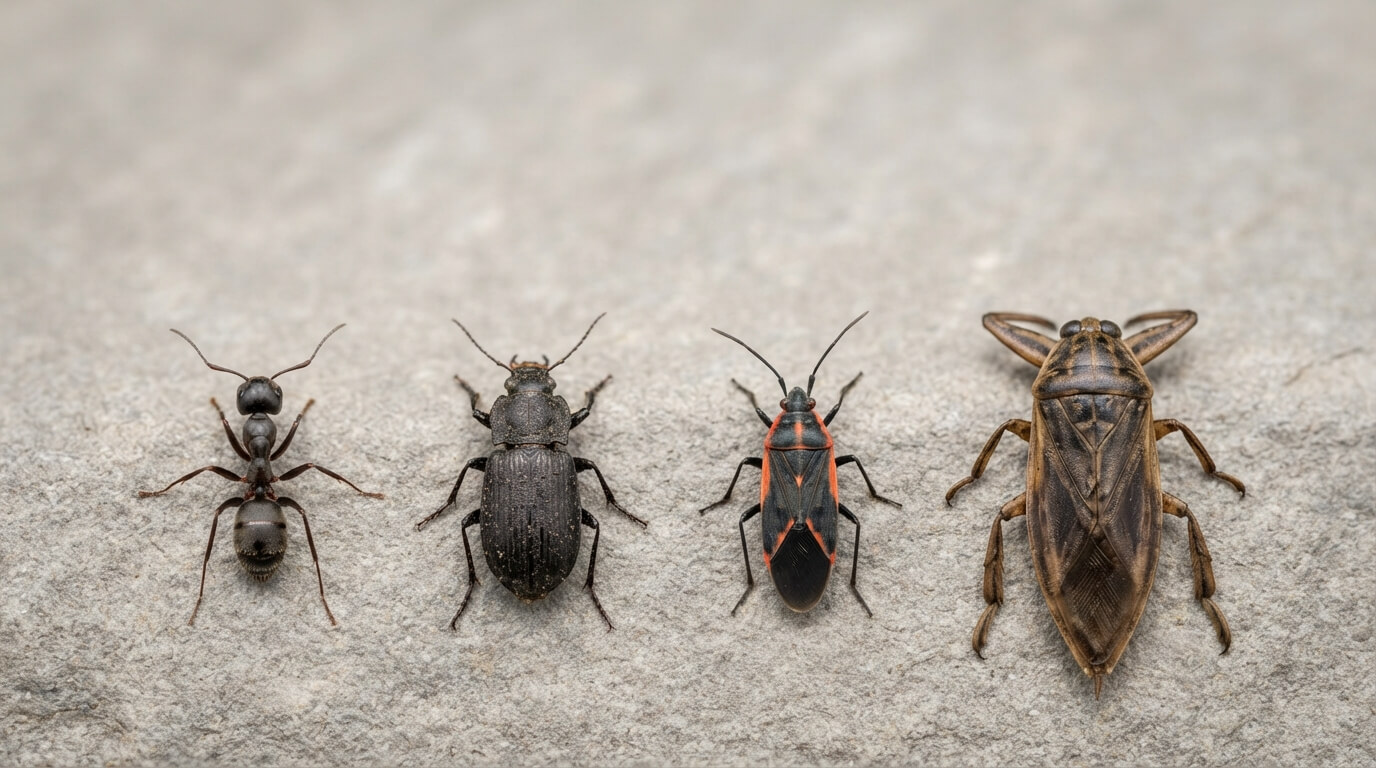
A big black bug in Ontario is most often a ground beetle, a black carpenter ant or, if it has red markings, a boxelder bug. Only the carpenter ant can damage a building. Near ponds and porch lights, the culprit may be a giant water bug, the largest true bug in Canada. Below, you’ll learn how to tell them apart, which ones are harmless, and when to act.
How Can You Tell Which Big Black Bug You Have?
Check the body shape first, then where you found the bug.
- Narrow waist and bent antennae: an ant. Ants have a constricted waist and elbowed antennae, while termites have a broad waist and straight antennae (Cornell IPM). cornell
- Flattened, hard body with thread-like antennae and no narrow waist: a ground beetle.
- Black with red lines on the wings and behind the head: a boxelder bug.
- Large, flat, brownish oval near water or bright lights: a giant water bug.
| Bug | Typical size | Red markings | Main concern |
| Ground beetle | 0.3 to 8.5 cm | No | None; accidental indoor visitor |
| Black carpenter ant | ¼ to ½ inch | No | Can damage wood |
| Boxelder bug | About ½ inch | Yes | Nuisance; stains fabric |
| Giant water bug | Up to 65 mm | No | Painful bite if handled |
What Are Black Carpenter Ants, and Do They Damage Buildings?
The black carpenter ant (Camponotus pennsylvanicus) is a dull black ant that nests in wood, and it is the one bug on this list that can harm a structure. The University of Arkansas describes it as the most important structural pest in the eastern and central United States and in southeastern and south-central Canada, with workers ¼ to ½ inch long (University of Arkansas).
These ants tunnel through wood to make nesting space but don’t eat it, and they prefer moist wood because it is easier to excavate. Damp window frames, decks and areas near leaks are the usual trouble spots. Because the nests are inside the wood, damage isn’t always visible from outside.
Winged ants indoors deserve attention. Texas A&M entomologists note that winged carpenter ants inside a home can indicate structural damage (Texas A&M). Workers also can bite and inject formic acid, which can be quite painful, although they don’t sting (Texas A&M). tamutamu
Are Ground Beetles Dangerous?
Ground beetles are harmless predators that end up indoors by accident. Ontario’s Ministry of Agriculture (OMAFRA) describes adults as elongate, flattened, usually dark brown to black, and 0.3 to 8.5 cm long, and records 59 species in southern Ontario apple orchards (OMFRA).
Iowa State University Extension says they do not attack people, pets or structures, feed on insect larvae outdoors, and enter through cracks and open doorways, sometimes drawn by lights (Iowa State). A vacuum and some caulk usually solve the problem.
What Is the Black Bug With Red Wings?
A black bug with red wings is usually a boxelder bug (Boisea trivittata). West Virginia University Extension describes adults as about ½ inch long and mostly black, with reddish-orange wing margins, three lines on the thorax and an orange-red abdomen, while the nymphs are bright red (WVU Extension).
Red “spots” on a black bug may be that red abdomen or those wing edges. One look-alike, the small milkweed bug, is distinguished by a white spot on the hindwings (Colorado State University). colostate
UMass Extension notes the species occurs in eastern Canada, gathers on the sunny sides of buildings and trees, and enters buildings to overwinter without biting, stinging or damaging the structure (UMass Amherst). The nuisance is that crushed bugs smell and their excrement can spot fabrics.
What Is the Biggest Bug in Ontario, and the Largest Flying Bug?
The giant water bug (Lethocerus americanus) is the largest true bug in Canada, and it flies. The Canadian biodiversity database hosted by Library and Archives Canada lists it as widespread in Canada, up to 65 mm long, and attracted to electric lights at night (Library and Archives Canada). The University of Maine calls it the largest member of the true-bug order (Hemiptera) in the US and Canada.
There’s a technical catch when people ask what the biggest bug is. In entomology, “bug” means a true bug, so ants and beetles aren’t bugs at all. Whether this species is also the biggest insect in Ontario depends on whether size means length, wingspan or weight, so “largest true bug” is the claim the sources support.
Leave giant water bugs alone. They can inflict a painful bite if handled carelessly.
What Should You Do About a Big Black Bug in Your Home?
Identify the bug first, because the right response depends on the species. For most, prevention works better than treatment:
- Vacuum instead of crushing. Colorado State recommends vacuuming boxelder bugs found indoors.
- Seal entry points. Caulk gaps around windows, doors, siding and plumbing, and screen vents, ideally before late summer.
- Fix moisture problems. Repair leaks and damp wood, which attract carpenter ants.
- Reduce bright lights near doors. Ground beetles and giant water bugs are both drawn to them.
When Should You Call a Pest Professional?
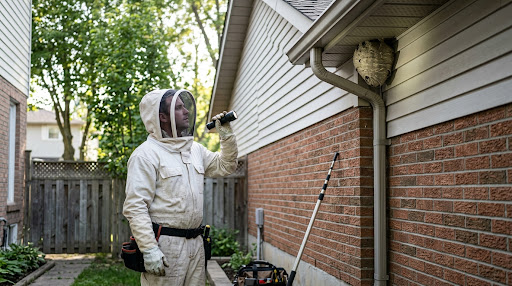
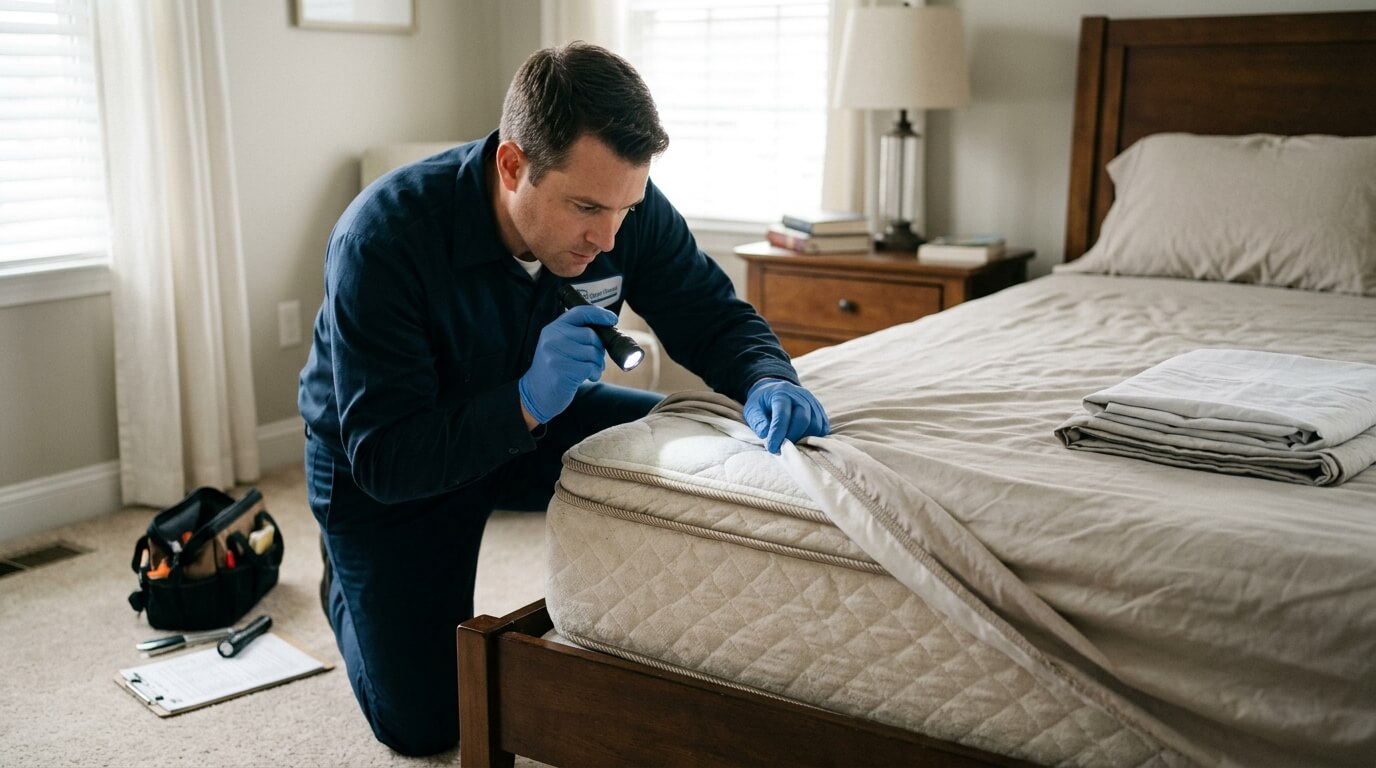
Call a professional when the bug looks like a carpenter ant, when winged ants appear indoors, or when numbers keep growing after entry points are sealed. Beetles and boxelder bugs rarely justify treatment.
For restaurants, offices and warehouses, a carpenter ant colony inside a wall is easy to miss. An inspection from a commercial provider such as Ultimate Pest Solutions can confirm the species and locate the nest.
Frequently Asked Questions
Do big black bugs in Ontario bite?
Most don’t. Ground beetles and boxelder bugs don’t bite people, according to the sources above. Carpenter ants and giant water bugs can, so don’t handle them.
Does one big black bug indoors mean an infestation?
Usually not. A single ground beetle or a few boxelder bugs in fall are typically accidental. Several carpenter ants, or winged ones, indoors point more strongly to a nearby nest.
Conclusion
Most big black bugs in Ontario are harmless. Ground beetles and boxelder bugs are outdoor insects that stray inside, and giant water bugs stay near water and lights. Carpenter ants are the one to take seriously: the sign to watch for is moisture-damaged wood or winged ants indoors. If you can’t identify what you’re seeing, or it keeps coming back, get it inspected before damage builds.